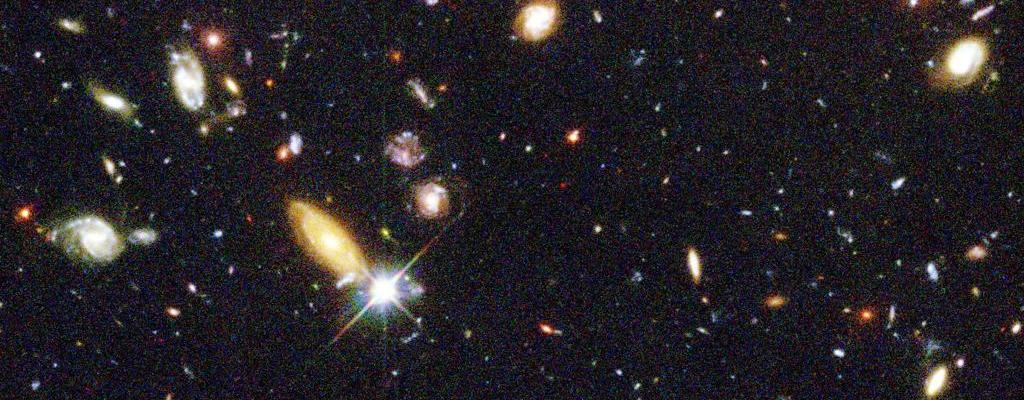
Are we alone?
Ever since humankind began exploring, we asked that one question over and over.
When we looked to the stars, the question took on new meaning. We began asking if our little blue marble was the only source of life in the infinite darkness of space.
Unfortunately, space is incomprehensibly big. If the sun was a grain of sand and the Earth was an inch away, the next closest grain of sand, called Proxima Centauri, would be 4.3 miles away, with almost nothing but a black void and some dust in between.
But the sheer size also has its benefits. Even though each grain of sand is miles apart, there are also about 400 billion of them in the Milky Way galaxy alone, each with its own history and possibility of life.
The question is so persistent in humanity’s mind that we created the Search for Life in the Universe Institue, also called SETI, and some colleges gives classes on what needs to be considered when looking for alien life.
Dr. Alan Calder, an Associate Professor of Stony Brook University’s Department of Physics and Astronomy, teaches one such class, which is popular enough at the school to be taught every semester.
He outlined the class as going through:
·The Greats, like Kepler, Newton and Galileo
·Where life might be
·What life is
·Where and how life arose on the Earth
·Looking for life
·What would aliens be like
·How to communicate over stellar distances
·Convergent evolution, the need for hands and maybe vision
·Speculation about what other civilizations may be like
“We end with the Fermi question,” he said. “That is, if there’s no evidence for we’re special… then where is everybody?”
He said that one of the tools to answer the question is the Drake Equation, created by Frank Drake in 1961 to answer whether we are indeed alone in the universe.
The equation starts with known knowns, things we know are needed for life as we know it to exist and we have some understanding of how likely they are.
The first restriction: only consider the Milky Way galaxy. Space is big, and the nearest galaxy, Andromeda, is more than 2,500,000 light years away. If the nearest grain of sand is 4.3 miles away, the edge of Andromeda is more than 10 times the distance to the Moon.
“Other galaxies are so far away that if there is life there, we have virtually no chance of meaningfully interacting with it,” Calder said.
With that in mind, all stars in the Milky Way (ignoring dead ones like neutron stars and white dwarves) are viable places to search for life. Each roaring sphere of nuclear fusion-powered plasma, from the coolest red dwarfs to the hottest blue supergiants, has its own unique fingerprint of light, and all could theoretically support life in an area called the habitable zone.
In a star’s habitable zone, also called the “Goldilocks Zone,” water gets hot enough because of the star’s light that it unfreezes from the mind-numbing cold vacuum of space, but not so hot that it evaporates into vapor.
“Conceivably, all stars have some habitable zone,” Calder said. “But other factors, like the star’s lifetime, it’s location in the galaxy and other properties of it are important in determining how likely there would be life around that star.”
The problem is that the larger and brighter the star, the easier it is to see but the more quickly it burns through all of its fuel and dies, killing any life in the solar system along with it. But a very small star may sterilize a planet with radiation because of how close the habitable zone might be to the star.
The other problem Calder mentioned is known as the Galactic Habitable Zone, or GHZ. Just like how a planet needs to be a certain distance from its parent star for liquid water to exist, the galaxy has a habitable zone. Go too far in, radiation from stars sterilizes any planet. Go too far out, there are not enough metals like carbon to support as many rocky worlds where life might arise.
“Metals are the astronomer term for anything that is not hydrogen or helium,” Calder said. “The iron in our blood, the calcium in our bones, the carbon in everything. That’s all metals.”
Calder said that in total, life as we know it needs three ingredients in order to start – a source of carbon, liquid water and energy.
Ignoring for the sake of simplicity the frigid moons of gas giants and heat from radioactive decay in a planet’s core, liquid water is most likely to form from the heat of a planet’s parent star, which also gives life an energy source.
So to find life, we may only need to look for stars with planets in the Goldilocks Zone. Current technology like the Kepler telescope can find these planets more easily than ever before.
Out of a little over 3,400 confirmed exoplanets, Kepler has detected over 2,300, according to the NASA Exoplanet Archive. Normally, a planet is completely lost in the glow of its parent star, like an unlit match against a flood light.
However, scientists realized that they could think of the problem in reverse, that when a planet orbits in front of its parent star, it casts a minute shadow.
The shadow is so small that the human eye cannot see any change. Satellites are patient though, unblinkingly observing the night sky for as long as needed.
Once a planet with a primordial soup of water and carbon is found, one question needs to be answered.
Does it have life?
It is here that the Drake Equation takes a hard left turn into philosophy and biology as it goes from known knowns to known unknowns, the things we know need to happen, but do not have solid answers for.
The first known unknown: what is the probability that life will spontaneously arise given the right ingredients?
Calder turns to the fossil record to argue that life in some form could be common. After all, when the Earth first formed, it was a molten ball of rock being bombarded by comets, asteroids and even another protoplanet. Only 500 million years later, we have found evidence for life in the still burning primordial oceans via scraps of graphite in time capsules of the mineral zircon.
But intelligent life may be trickier. For much of the time life existed on Earth, it stayed fairly simple as just single cells or small colonies. Then, 3.5 billion years later, evolution decided to kick into high gear with the Cambrian explosion, when life suddenly started becoming more complex.
Although we do not know what caused the Cambrian explosion, we know that it acted as a proving ground for complex life, testing out different and often bizarre possibilities, like Opabinia’s five eyes or Hallucigenia sparsa’s Lovecraftian neck tentacles.
Dr. Jeffrey Levinton, Distinguished Professor of Ecology and Evolution at Stony Brook University, said that the Cambrian Explosion led to all but one group of animals that we know of today, and that the remaining group may only have not been found because we do not have enough fossils.
Kalder argues that since simple life existed for so long and multicellular life only arose recently, life is potentially quite common in the universe, but complex life is a much rarer gem.
“I’m in the camp that Earth is relatively rare,” he said. “I think there’s a good chance that there’s life on a planet similar to ours out there somewhere. But the really rare part is that the planet has had a very stable climate for billions of years so that intelligent life, like us, could evolve.”
Unfortunately, space is big, and life simply occurring is not enough at the moment. In order to prove that life exists outside of the Earth, scientists need to receive some kind of message from the stars.
This is where the Drake Equation transforms again. This time going from biology and philosophy to sociology, as scientists attempt to answer the likelihood of intelligent life developing radio technology, and how long a civilization can last before it dies out.
While the answer of how likely life is has some evidence backing up claims, there are no answers to these final questions. Instead, scientists simply scan the heavens, looking for something intelligent.
Seth Shostak, a Senior Assistant at the Search for Extraterrestrial Intelligence Institute, or SETI, said that when they stare at the sky, searching for an intelligent signal, scientists used to mainly look in the “water hole,” a frequency of radio waves associated with water, and thus life and potentially intelligence, that is not lost in the dust between stars or the background cosmic radiation of the universe.
However, Shostak said that currently, they scan a much larger area of radio waves, all the way from 13,000Mhz, where each wave is 76 feet long, to 1,000Mhz, or a 990-foot wave. For comparison, yellow light, like from the Sun, has a 570 nanometer wave, or over 526,000,000Mhz.
While trying to make contact in some way, scientists try to figure out how long a civilization can survive before it dies out because space is big. The Milky Way galaxy alone is 100,000 light years across, so a civilization on the other side of the galaxy would need to stay alive for 200,000 years just for humanity to receive its first signals and send something back.
Given that since the invention of the radio in the 1830s humanity has had two world wars, countless other conflicts and developed nuclear weapons, figuring out how long a civilization can last may be helpful in figuring out which stars are too far away to send a message back before its citizens die.
One problem the Drake Equation does not directly address are unknown unknowns, the variables that we simply do not know whether they are needed in order for life to arise or not.
For instance, does a planet require a large, stabilizing moon? Does a solar system need a planet like Jupiter to be an asteroid vacuum in order to protect other planets from bombardment?
Calder gave another example of an unknown unknown.
“We tend to find planets like Jupiter tightly orbiting, like within the orbit of Mercury, for example,” he said. “If it is normal for solar systems to wide up like that, then why didn’t ours?”
One last consideration is to invert the problem. Set the Drake Equation equal to one and see what you need to do in order to make humanity the only life in the universe. The Milky Way galaxy has around 400,000,000,000 stars, and the most recent data suggests that there are as many as 1,000,000,000,000 galaxies in the observable universe, and some galaxies are known to have as many as 100,000,000,000,000 stars, each possibility sustaining some form of life.
In a visible universe that has had around 13,500,000,000 years to change and which has “more stars than there are grains of sand on all of the beaches in the world,” according to Dr. Neil DeGrasse Tyson, director of the Hayden Planetarium, with each star potentially sustaining life in some form, are we alone?
As Carl Sagan said in “Contact,” “The universe is a pretty big place. If it’s just us, seems like an awful waste of space.”
 Kevin Matyi Journalism